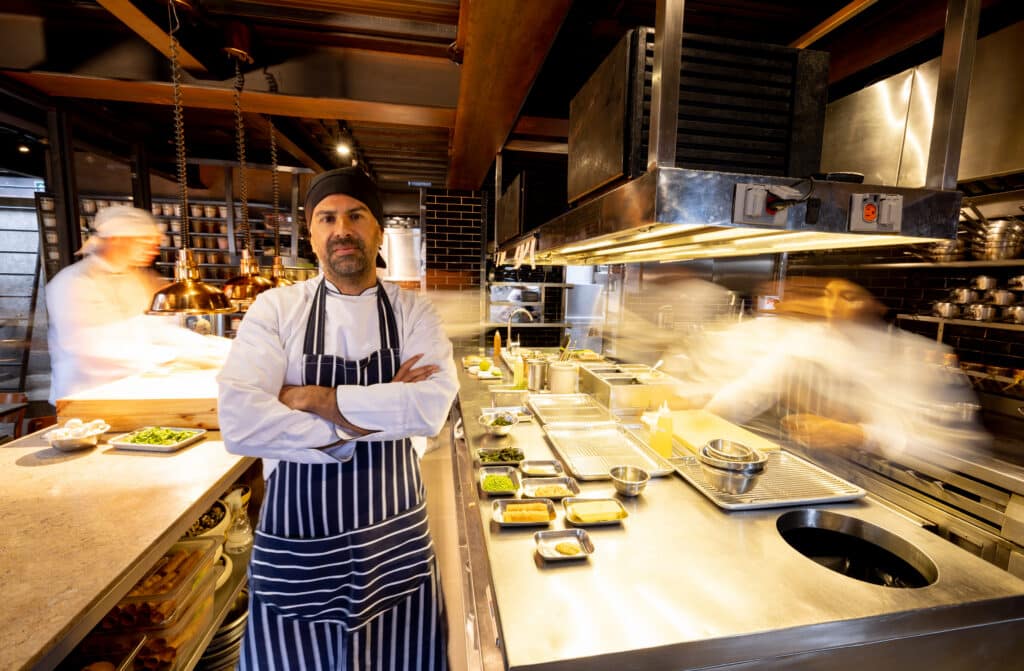
In our recent customer-led webinar, two independent restaurant operators sat down with Restaurant365 Solutions Architect Marc Cohen to share how they’re actually using AI in their day-to-day operations: Donna Wilkins of Juliet Italian Kitchen and Ramon Soriano of La Calle.
Below are five actionable lessons any operator can take back to their restaurant immediately.
The most common mistake operators make with AI isn’t using it wrong. It’s thinking about it wrong. Marc Cohen put it plainly: “It is not a search engine. It is far from it.”
Donna framed AI as a personal consultant, not just an assistant. That distinction matters because a search engine retrieves, while a consultant synthesizes, questions, and pushes back.
Ramon’s “aha moment” came when he used ChatGPT to troubleshoot a broken ice machine. Instead of getting a list of links to dig through, it gave him step-by-step instructions, and when he got stuck, it guided him to the next move, unprompted.
What this looks like in practice:
Neither Donna nor Ramon started AI with a formal adoption plan. They started with a problem in front of them.
For Ramon, it was a lease he needed reviewed over a Disney trip weekend. He uploaded the 150-page document to ChatGPT and had a full breakdown in seconds: what was in his favor, what wasn’t, and what was negotiable. That was the moment he stopped treating AI as optional.
For Donna, it was $7,000 of off-menu wine inventory sitting in storage. She fed the list to AI, asked which wines belonged on the by-the-glass menu versus the bottle list, requested market-appropriate pricing, and cross-referenced it against the full food menu for upsell opportunities.
Ramon also used AI to review architectural drawings for a restaurant under construction. By uploading screenshots of the plans, he caught that the bar was spec’d with the wrong countertop material, a mistake that would have cost roughly $25,000 to fix after the fact.
The takeaway: don’t wait until you have a “strategy.” Pick the most pressing problem on your desk and throw it at the tool.
There’s real fear in the workplace right now that AI is coming for jobs. Marc addressed it directly: “We’re replacing tasks. Not careers.”
In hospitality, that distinction is especially important. Restaurants run on human interaction. Guests aren’t coming for a bot. But they are noticing when servers are buried in administrative work instead of focused on the table.
Donna’s approach to buy-in was to actively normalize AI use with her team. When a staff member sheepishly admitted they’d used ChatGPT to write an SOP, she celebrated it. The expectation she set: use the tool, but own the output.
Ramon took a different approach. His team has access to all operating manuals, HR policies, and procedures through a shared platform. Managers no longer need to spend hours hunting for the right form or policy. They ask the tool. The result: they ask Ramon fewer questions, and they’re more confident acting on their own.
Marc’s framing: “Ask your team members what’s the least favorite part of the job. If we can find some sort of automation or replacement for that, those little wins are huge for employees.”
Both operators are using AI to squeeze more value out of the data they’re already collecting in Restaurant365. And the connection is more direct than most operators realize.
Donna uploads P&Ls directly to AI for a first-pass analysis, not to replace her own methodology, but to catch what she might be overlooking or what she’s become too comfortable to question. She also runs weekly menu reviews, layering in real performance data to build trend analysis week over week. She calls it the ability to do “rapid iterations” on decisions that previously would have waited a month.
For operators ready to connect the two, start here:
The biggest mistake Donna and Ramon both flagged? Waiting. Ramon’s business partner started using AI six months before he did, and the gap in comfort and fluency was immediately visible.
Marc put the urgency in context: “We are only three and a half years into this journey with AI. We are at a tipping point.” The tools are self-improving faster than operators can track, and the operators who are building the habit now will have a compounding advantage over those who don’t.
Donna’s advice for anyone just getting started: “Give yourself an hour or two to sit down and experiment. For most people, they’ll be blown away by what’s in there.”
And when you get an answer you like, or one you don’t, respond to it. Upvote it. Push back. The more context you give the tool about your restaurant, your culture, and your concepts, the more tailored and useful the output becomes.
Marc’s closing mantra: “Ask, rephrase, iterate. Stay small. Stay practical. Move fast.”
Blog Menu
See why more than 50,000 restaurants use Restaurant365
The operators on this webinar aren’t running 200-unit chains with dedicated technology teams. They’re running scratch kitchens, taco concepts, and cocktail bars with lean teams and real margin pressure. And they’re using AI every day.
If you’re still on the sidelines, consider:
AI won’t replace the hospitality in your restaurant. But it can give you and your team more time to deliver it.
Share this blog:
See why more than 50,000 restaurants use Restaurant365
Restaurant365 brings together accounting, operations, scheduling, and more in a flexible platform—empowering restaurants to choose the solutions they need and scale with confidence.