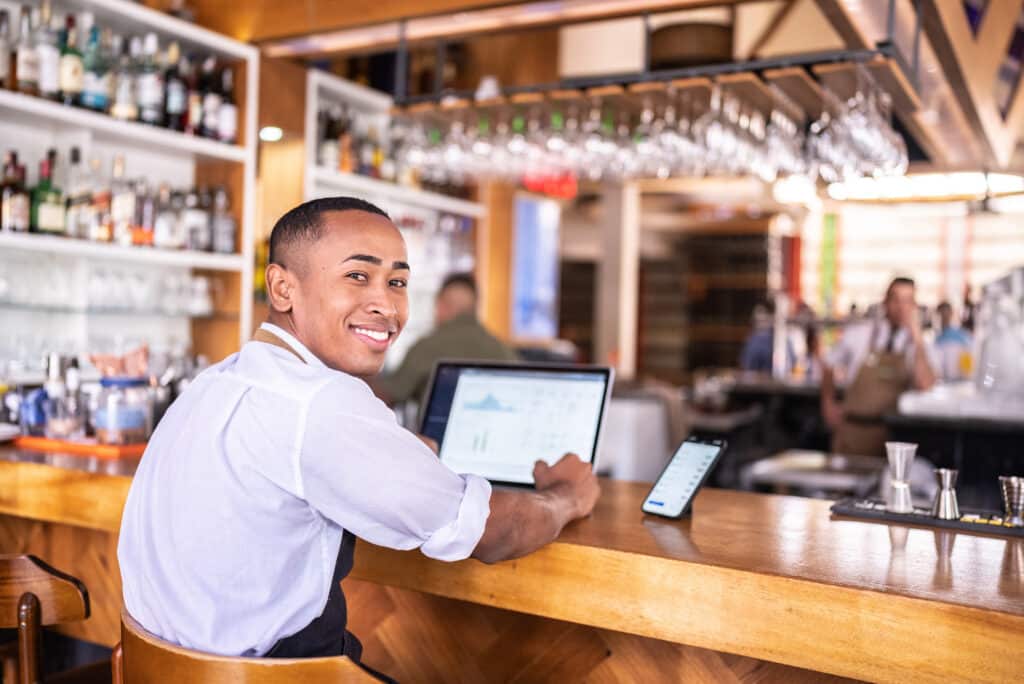
As you grow beyond one location, complexity compounds. Restaurant tech that connects accounting, inventory, and workforce management lets you standardize processes, compare performance across stores, and scale without adding unnecessary overhead.
Margins are tight — but they don’t erode all at once. They slip through small gaps: a 1.5% food cost variance that goes unnoticed for weeks, overtime that creeps in because schedules aren’t tied to sales, invoices that don’t match purchase orders, or reporting that arrives too late to correct course.
Without the right restaurant technology, operators are constantly in cleanup mode. By the time the P&L closes, the damage is already done.
Essential restaurant tech changes that by giving operators control at the source:
Automated accounting workflows that post sales, reconcile bank activity, and process invoices daily — not at month-end
Real-time prime cost visibility that ties labor and food cost directly to sales performance
Theoretical vs. actual inventory tracking to flag variance before it compounds across multiple locations
Sales-based labor scheduling that aligns staffing levels with projected demand
Standardized, AI-driven reporting and intelligence across stores so leadership can spot outliers immediately
Instead of waiting for accounting to “close the books,” operators can monitor performance throughout the week and make adjustments in real time, tightening purchasing, correcting portioning issues, or adjusting labor before costs spiral.
Run smarter across every location you operate.
See how R365 makes it easier.
Not all restaurant technology is created equal. The best systems are purpose-built for restaurant operations, not adapted from generic accounting software.
When evaluating restaurant tech, look for:
Restaurant365 brings these capabilities together in a single system designed specifically for restaurant operators.
Want to see how operators are modernizing their tech stack? Watch our free webinar, Why Multi-Unit Operators Are Standardizing on R365.
The most powerful restaurant tech isn’t a collection of disconnected apps. Instead, it’s a connected platform.
With a unified system like Restaurant365, data flows automatically from your POS, vendors, and payroll providers into accounting and reporting. Operators can:
View real-time dashboards for sales, labor, COGS, and prime cost
Track inventory variance and food cost trends
Automate accounts payable and bank reconciliations
Generate multi-location financial reports instantly
Share performance insights with managers and stakeholders
Instead of stitching together spreadsheets, operators gain a single source of truth for the entire business.
As SERVE Hospitality Group grew its Tropical Smoothie Cafe portfolio across Illinois, Michigan, and Wisconsin, complexity increased quickly. What worked at a smaller scale — manual accounting processes and disconnected reporting — wasn’t sustainable as new stores came online.
Owner and CEO Salem Najjar needed a restaurant-specific system that could support multi-entity operations without adding headcount.
Before Restaurant365, SERVE faced:
Manual intercompany transfers between entities
Financial reports that lag behind real performance
Limited visibility into store-level prime cost
Time-consuming reconciliations that slowed decision-making
The accounting team spent too much time cleaning up data — and not enough time analyzing it.
After implementing Restaurant365, SERVE centralized accounting and operational data into one platform. Intercompany transactions were automated. POS and inventory data flowed directly into financial reporting. Leadership gained real-time visibility into Prime Cost across every store.
The measurable impact:
$80,000 saved annually in accounting costs
100+ hours of manual accounting work eliminated each year
Doubling the number of locations without adding accounting staff
Instant visibility into performance across all 14 stores
By standardizing workflows and consolidating reporting, SERVE moved from reactive accounting to proactive financial management — with the infrastructure to support continued growth.
Tropical Smoothie Cafe franchisee SERVE Hospitality Group shows what connected restaurant tech can actually deliver in practice. See how Restaurant365 can help you streamline operations and protect margins. Get a free demo of R365.
✅ Real-time reporting across locations
✅ Integrated accounting, inventory, payroll, and scheduling
✅ Multi-entity support for growing brands
✅ Built specifically for restaurant operators
✅ Basic financial reporting
❌ Not built for restaurant-specific workflows
❌ Limited inventory and labor visibility
❌ Requires manual POS imports
✅ Specialized features
❌ Fragmented data across systems
❌ Duplicate data entry
❌ No unified reporting or single source of truth
Restaurant tech refers to the software and systems used to manage operations, including POS, accounting, inventory, scheduling, payroll, and reporting. Modern platforms connect these tools to create a unified operational view.
At minimum: a POS system, inventory management, labor scheduling, payroll, and restaurant-specific accounting. The most effective setups integrate these tools into one connected platform.
By automating manual processes, reducing errors, and providing real-time visibility into costs. Operators can identify food cost variances, control labor, and make faster decisions.
Yes. Multi-unit brands benefit from centralized reporting, multi-entity accounting, and standardized processes across stores — all core capabilities of Restaurant365.
With the right implementation partner, migration can be structured and phased. Many operators see ROI quickly through time savings and improved cost control.
Turn technology into operational clarity.
See how Restaurant365 makes it easier.
The value of restaurant tech isn’t theoretical — it shows up in measurable operational improvements.
Substantial cost and time savings: SERVE Hospitality Group doubled its footprint and saved $80,000 annually in accounting costs after implementing Restaurant365, all while managing 14 locations with a single accountant.
Automated, accurate inventory tracking: Restaurant365’s inventory solution simplifies counts, transfers, and menu costing to surface issues faster.
Instant multi-location visibility: What once required days of reconciliation can now be reviewed in minutes with consolidated dashboards.
Comprehensive restaurant management: Accounting, payroll, scheduling, and inventory live in one system, reducing fragmentation and increasing control.
Modern restaurant tech isn’t just about automation. It’s about turning disconnected data into actionable insight that protects margins and supports growth.
Blog Menu
See why more than 40,000 restaurants use Restaurant365
Running a restaurant on disconnected systems creates friction, errors, and blind spots. Essential restaurant tech connects accounting, inventory, labor, and reporting so operators can see the full picture in real time.
With Restaurant365, your technology works together, giving you the clarity and control needed to grow profitably. Get a free demo today.
Share this blog:
See why more than 50,000 restaurants use Restaurant365

Restaurant365 brings together accounting, operations, scheduling, and more in a flexible platform—empowering restaurants to choose the solutions they need and scale with confidence.