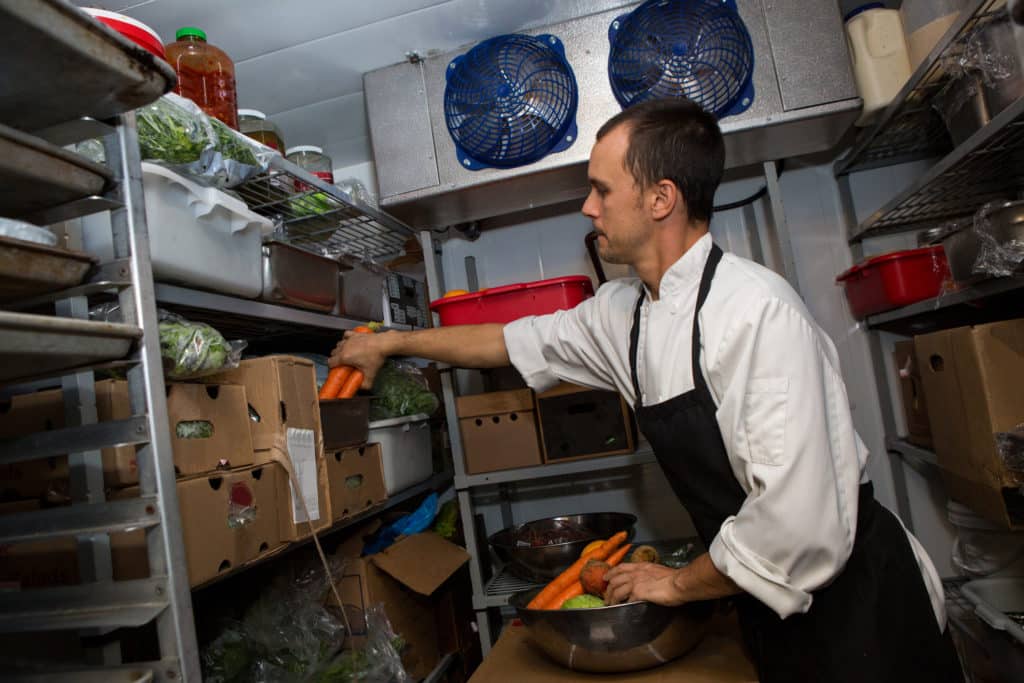
Small restaurants can lose money on purchasing and receiving without realizing it until it shows up in food costs. But the right purchasing and receiving tools catch problems before they compound.
This article covers the specific features worth paying attention to, the compliance considerations that affect how you receive food, and the storage practices that protect your margins after the delivery truck leaves. If you run a small restaurant and still check deliveries with a clipboard and pen, this is for you.
Here is what to verify every time a shipment arrives:
Inspect the delivery vehicle for cleanliness and proper temperature.
Check temperatures of all TCS (time/temperature control for safety) items immediately.
Compare delivered quantities against the purchase order, item by item.
Spot-check weights on proteins and other high-cost items.
Inspect packaging for damage, tears, or signs of thawing and refreezing.
Verify product quality: color, smell, and expiration dates.
Reject items that do not meet your standards and document the rejection.
Sign the delivery receipt only after completing your checks.
Enter received quantities into your purchasing system so inventory updates in real time.
For more detail on applying these checks consistently, see Restaurant365’s restaurant purchasing and receiving best practices guide, which you can post in your receiving area as a reference.
An F&B (food and beverage) purchase is any transaction where a restaurant buys ingredients, beverages, or supplies from a vendor for use in its operation. It covers everything from a weekly produce order to a one-off equipment buy.
The purchasing process in a restaurant is the full cycle from figuring out what you need to paying for what you received.
End-to-end procurement in a restaurant spans six connected stages: planning and par levels, purchase order creation, vendor management, delivery receiving, invoice reconciliation, and AP posting to the general ledger.
A gap at any stage creates cost problems that compound before they surface. Some frameworks split these into seven steps by separating supplier selection out as its own stage, but the core cycle stays the same: forecast what you need, order it, receive and verify it, then reconcile and pay for it.
Supplier selection matters more than small operators often realize. David Selby of Bourbon and Bones found that locations of the same brand in Arizona were paying $72 per pound and $53 per pound for the same product from the same vendor. Restaurant365 surfaced that discrepancy, a gap that might otherwise have gone unnoticed across locations.
Forecasting is where the cycle starts. If you do not know how much you will sell next week, you cannot order accurately. Restaurant365’s inventory and purchasing tools include sales forecasting, along with a purchasing dashboard that shows data for orders purchased and received by item, item category, and vendor.
A purchasing tool that does not talk to your inventory system creates double work. When purchasing and inventory share a single platform, every received delivery updates your on-hand counts, your theoretical food cost, and your cost-of-goods-sold calculations in real time. That single data model helps prevent duplicate data entry and mismatched costs.
Restaurant365 is the only platform that natively integrates restaurant-specific accounting, inventory management, workforce scheduling, payroll, HR, and business intelligence in a single system with a shared data model.
Competitors typically address only one or two of these areas. For a small restaurant, that means one login, one vendor relationship, and one place where all your numbers live.
Modern restaurant procurement platforms see more than 95% of invoices processed automatically, significantly speeding vendor payments and month-end close.
Bushfire Kitchen automated more than 80% of invoice processing within weeks of integrating Restaurant365 with key vendors. The Jimmy John’s franchisee Mitchell Management used EDI invoice automation to eliminate manual invoice entry and reduce the follow-up fixes that errors previously required.
“I’m working with it every single day, and I’m like, why don’t I have this for Jimmy John’s?” said Mitchell, on expanding Restaurant365 to Jimmy John’s locations.
For a small restaurant without a dedicated bookkeeper, automated invoice processing is the difference between spending Sunday night entering invoices and not.
Three-way matching automatically compares the purchase order, the receiving record, and the vendor invoice. When all three match, the invoice clears automatically. When they do not, the discrepancy gets flagged for review before you approve payment.
Bushfire Kitchen CEO Oliver Barwin put it plainly: “We’ve had alerts flag things like a $10,000 overcharge on a single beef invoice. Without that, it might never have been caught.”
David Selby caught a vendor error where his restaurant was charged for $12,000 of product but received only $6,000 worth. Three-way matching exists to catch exactly that kind of discrepancy before it turns into a bigger loss.
Restaurant365’s purchasing and receiving tools automate this comparison so you do not have to do it by hand.
ServSafe certification trains restaurant staff on food safety practices that directly affect purchasing and receiving: how to inspect deliveries, what temperatures to check, when to reject a shipment, and how to store items properly. For small restaurants where the same person might order, receive, and prep food, ServSafe training connects those tasks to a consistent standard.
The connection between ServSafe and purchasing is practical. A manager who knows that frozen fish arriving at an unsafe temperature should be rejected will save you from a foodborne illness complaint. A manager without that training might put it in the freezer and hope for the best.
Restaurant365’s best practices guide for purchasing and receiving covers the operational side of these compliance requirements, including delivery scheduling, quality checks, and staff training recommendations.
A receiving area is the designated space where deliveries are inspected, verified, and prepared for storage. It should be clean, well-lit, and equipped with a scale, thermometer, and enough room to open and inspect cases. In practice, many small restaurants receive deliveries through the back door into a cramped hallway. That is a problem. If your receiving area makes it hard to check deliveries properly, your staff will skip steps.
The Jimmy John’s franchisee Mitchell Management found this especially true in airport locations, where storage was separate from the storefront. Sheet-to-shelf counting replaced paper counts, reducing missed items and rework in those constrained spaces.
FIFO (First In, First Out) means older inventory gets used before newer inventory. It is the single most important storage practice for reducing waste. When a delivery arrives, new items go behind existing stock. Every item gets a date label.
Labeling is the mechanism that makes FIFO work. A container of diced onions with no date label will sit in the walk-in until someone smells it. A container with “6/14” written on the lid gets used Tuesday.
Tips for organizing storage areas:
Label every item with the date received or the date prepped.
Store raw proteins below ready-to-eat items to prevent cross-contamination.
Keep shelving at least 6 inches off the floor.
Group items by category so staff can find what they need without digging.
Audit your walk-in and dry storage weekly for expired or mislabeled items.
Felipe’s Mexican Taqueria drove down cost of goods sold by 5 percentage points, from 28% to 23%, across 5 locations. That result came from combining Restaurant365’s accounting, inventory and purchasing, and workforce management tools. Pike Howard, Director of Development and Finance at Felipe’s, said: “They’re given the information to know exactly what they should be purchasing, and if all of a sudden things don’t go according to plan, there’s no finger-pointing; we’re finding a solution.”
Our customers’ results illustrate what happens when purchasing and receiving move from manual processes to a connected system.
Nick’s Pizza & Pub saves $70,000 per year after integrating R365 with their Aloha POS. Ordering, receiving, transferring, and tracking inventory became one workflow instead of several disconnected ones. Nick Sarillo, the owner, said: “With R365, I can ask any manager at any time to look at a P&L and pull out details of any category. I can obtain the information I need in a fast and efficient manner.”
Kerbey Lane replaced Aloha Inventory and MAS90 accounting with Restaurant365 across 5 locations and a commissary. Their electronic ordering system now works like this: new order quantities go into a standing order, a purchase order automatically goes to the vendor, restaurants validate the delivery against the original order, vendor invoices automatically go to accounts payable, and AP only needs to print one check per vendor. Michael Jackson, Director of Restaurant Logistics at Kerbey Lane, said: “With Restaurant365, we save a huge amount of time by not having to do so many checks and balances. Restaurant365 gives us confidence that our numbers are always correct.”
Michael Leemann’s group (VRG) implemented Restaurant365 across 85 locations and 28 concepts within a year, starting with purchasing and AP as the foundation. They brought contract management in-house from a third party, using R365 for rebates and contract violation reporting. Leemann was direct about the impact: “Purchasing has been probably the biggest and quickest win for us, for sure.”
Kona Grill reduced costs by 15% after replacing spreadsheets with R365’s inventory and recipe management tools. Before that, it was difficult to track overcharges and recover credits from suppliers.
Blog Menu
The features that matter most for small restaurants are integration between purchasing and inventory, automated invoice processing, and three-way matching. These are not nice-to-haves. They are the difference between knowing your food cost and guessing at it.
More than 60,000 restaurant locations across the United States use Restaurant365. The platform handles purchase orders, receiving, vendor invoice matching, recipe costing, and theoretical-versus-actual food cost variance reporting, all connected to your general ledger.
Small restaurants deserve the same tools that multi-unit groups use to protect their margins. Your restaurant is a math problem. The question is whether you are solving it with data or guessing.
Schedule a free demo of Restaurant365 and see how purchasing and receiving work inside a system built for restaurants.
Last updated: October 2026.
Share this blog:
See why more than 60,000 restaurants use Restaurant365
Restaurant365 brings together accounting, operations, scheduling, and more in a flexible platform—empowering restaurants to choose the solutions they need and scale with confidence.